Stop guessing preflop. Start pricing it.
Every decision graded the instant you make it and costed in big blinds. Not “that was loose”: checking that set cost you 2.69bb. The leaks you can actually feel.
Runs in your browser · No sign-up to start · One-time payment, no subscription
At launch
6-max and full ring, 100bb, every street from the open to the river. Fundamentals included.
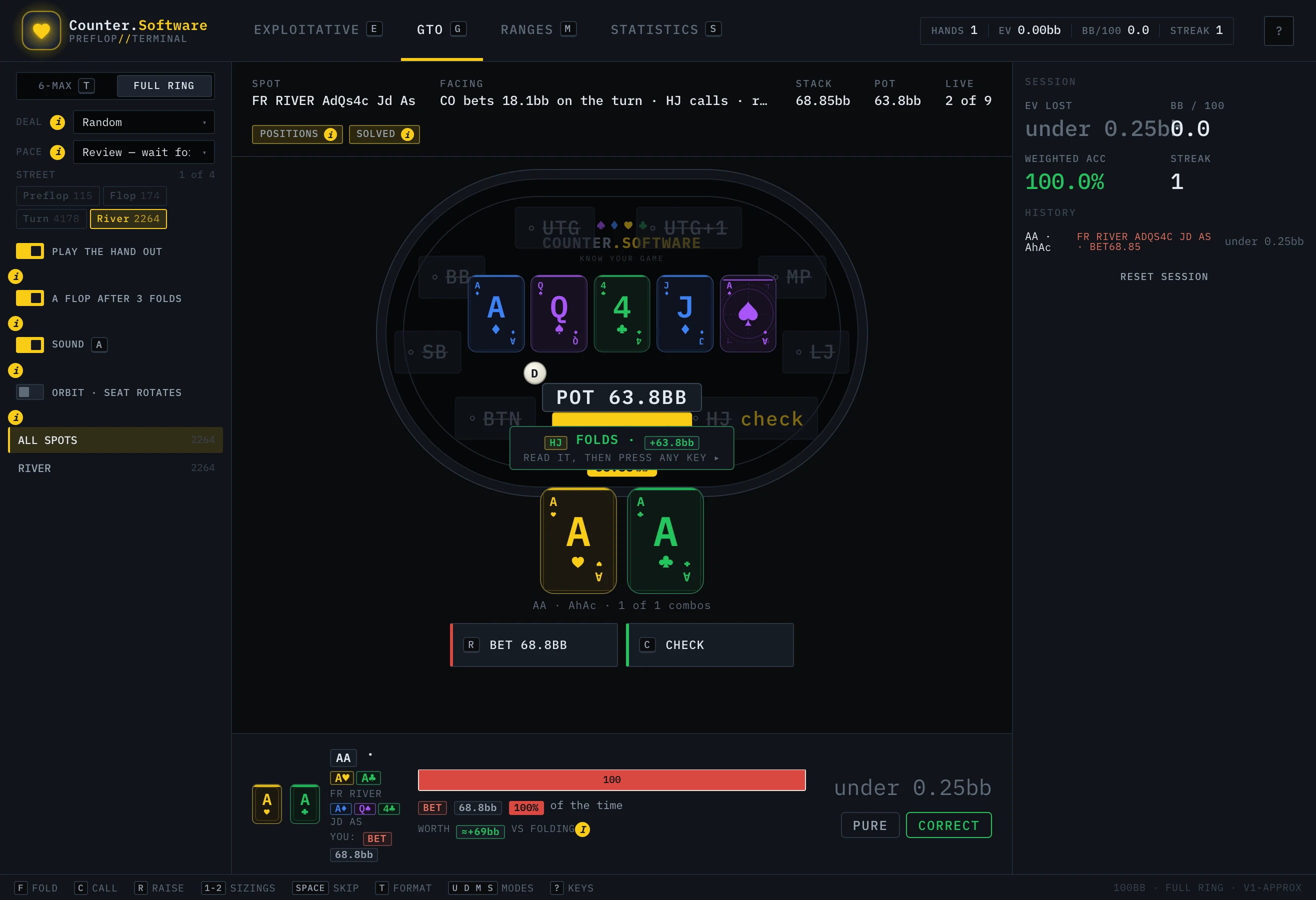
196 distinct flop boards · 42 with turn and river spots
The toolkit
Everything you need to stop leaking chips.
One engine grades every street, from the open to the river, in 6-max and full ring.
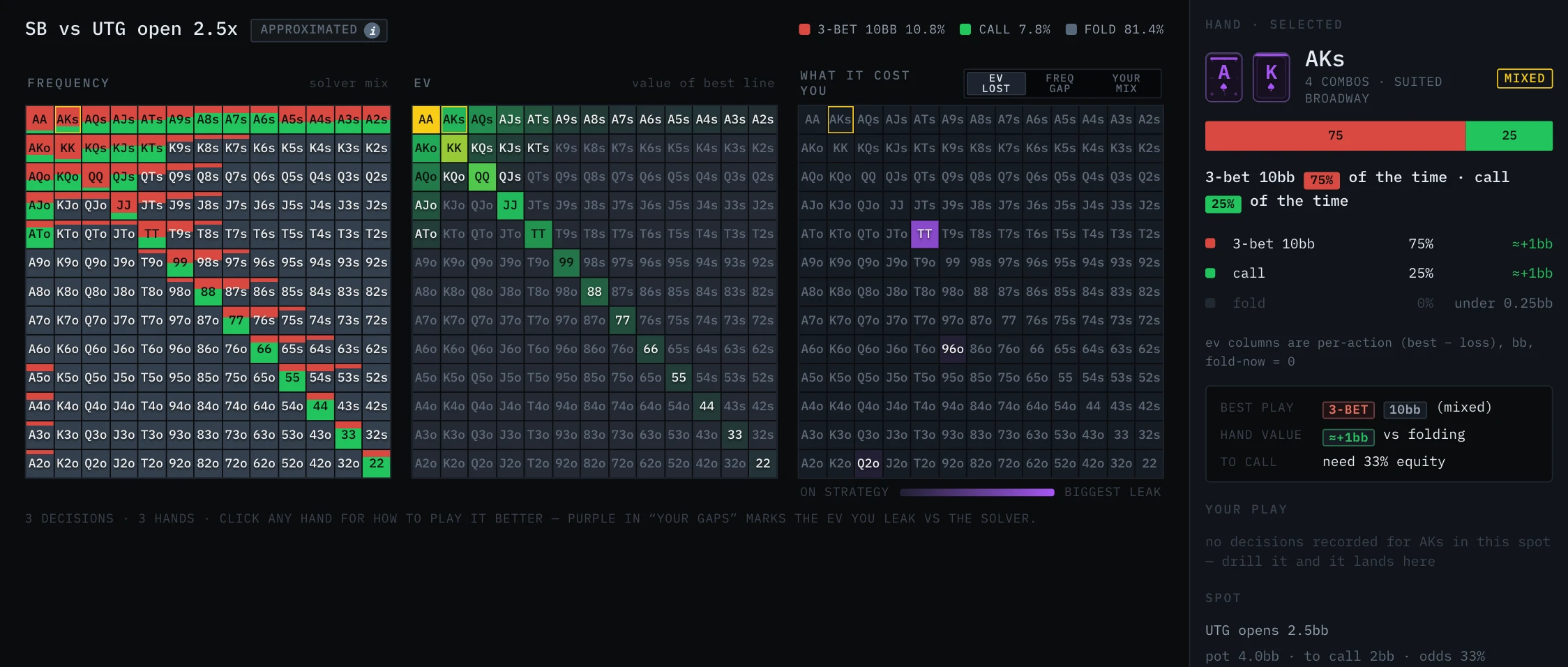
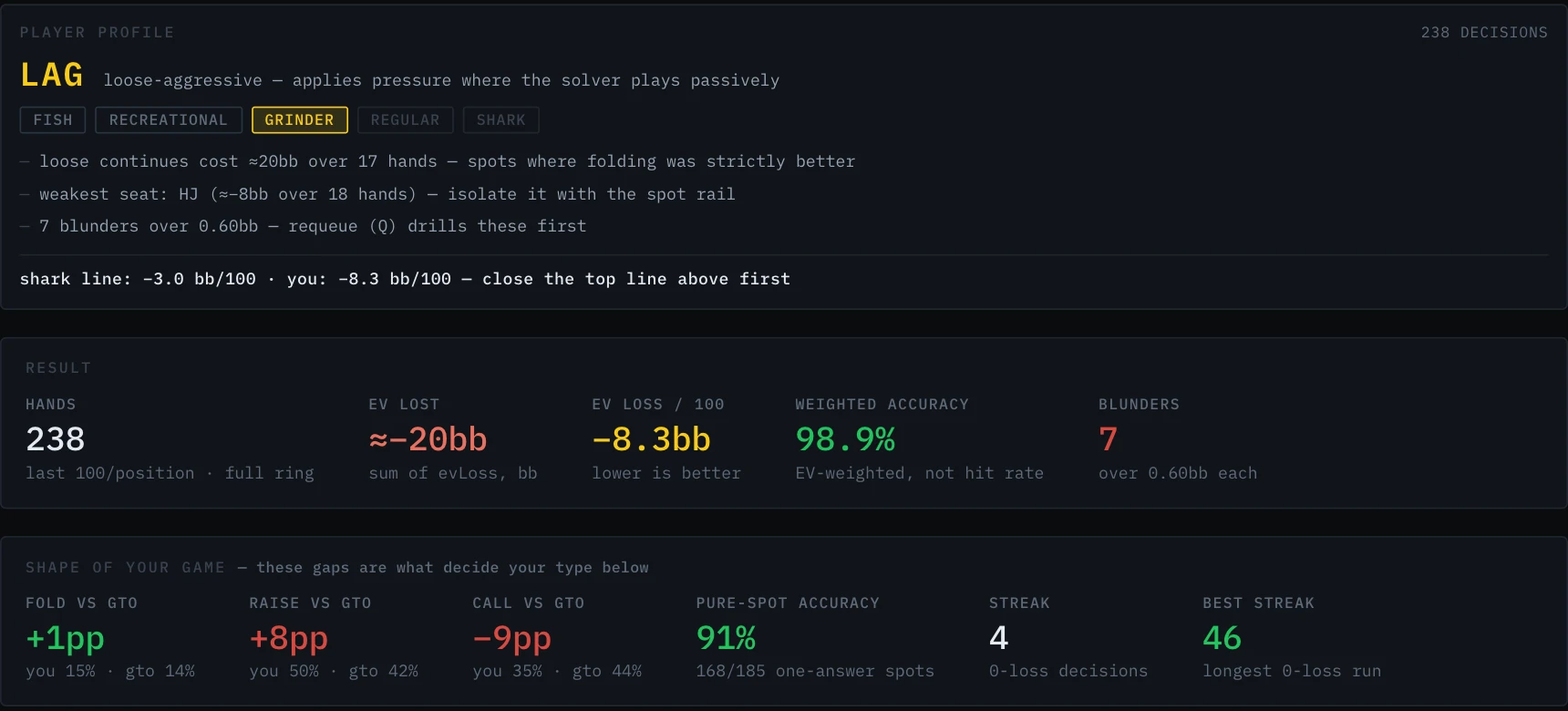
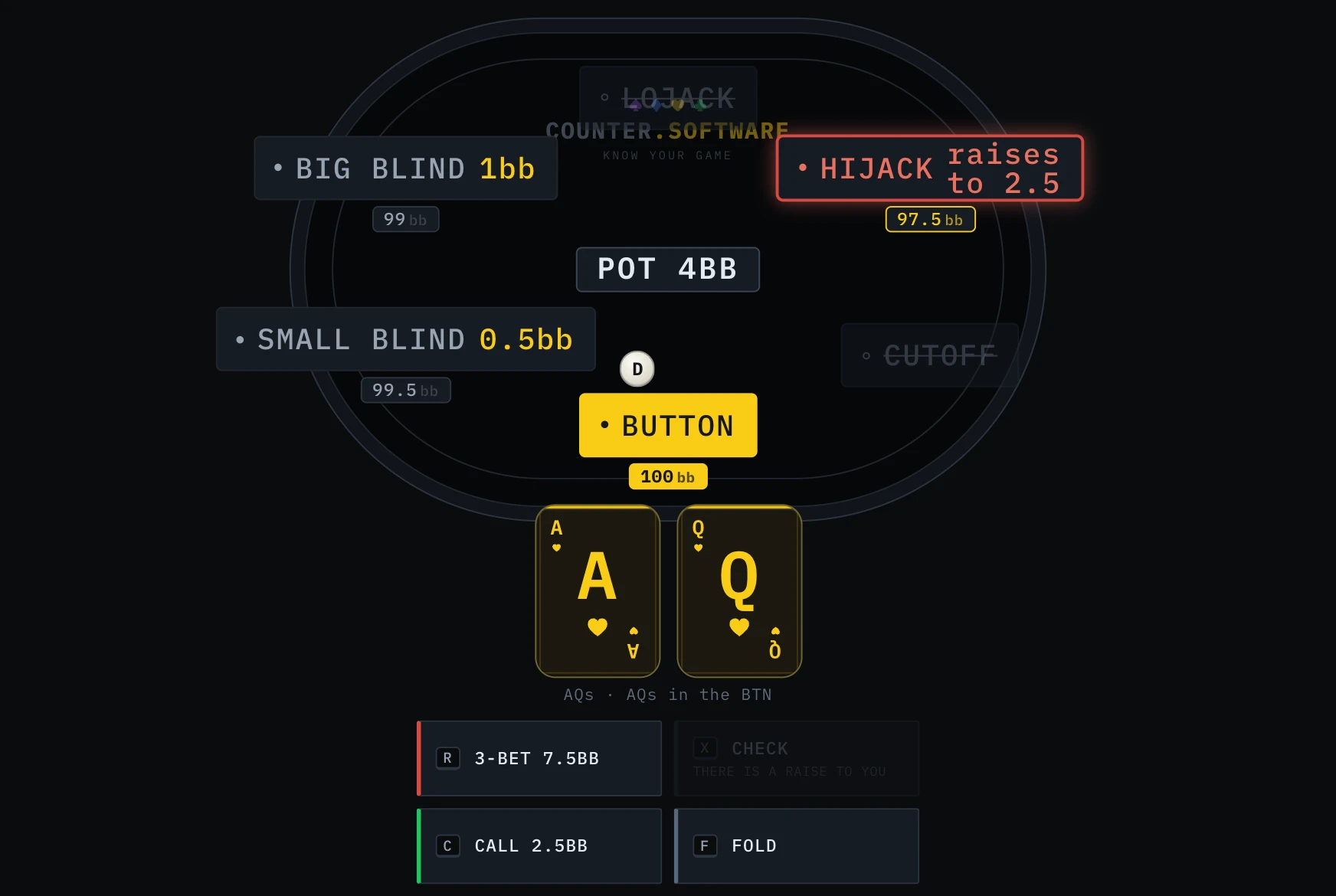
Priced, not scolded
Every decision costed in big blinds against the best line. Accuracy is EV-weighted, so a bad fold in a 4bb pot and one in an 83bb pot are never scored the same.
Keyboard-first
F to fold, C to call, R to raise, digits for sizings, space to skip. Your hands never leave the keys, so you drill at the speed you actually think.
Keyed to your exact cards
On this board the solver bets A♠5♠ 79% of the time and A♥5♥ just 14% — same “A5s”, opposite plans, because only one of them can make the nut flush. Averaging them into one row throws that away, so solved nodes are keyed by your exact two cards.
Play the hand out
Take the continuing line and the same cards carry to the flop, turn and river. One deal, up to four graded decisions, on the board you actually flopped.
Orbit mode
Take a seat and the button moves one to your left every hand, so your position rotates the way it does at a live table.
Both sides of the bet
Not just the aggressor. 7 of the 429 flops put you in front of a c-bet with call, fold and raise priced: the decision most trainers skip.
Deal it how you learn
Realistic deals, as the table gives them. Balanced gives every street equal time, Random spreads evenly, and Challenge feeds you the close, mixed decisions.
Leak tracking
Mistakes grouped by hand class, position, street and error type, ranked by the chips they cost. Requeue your ten worst hands with one key.
How it works
Deal. Decide. See the damage.
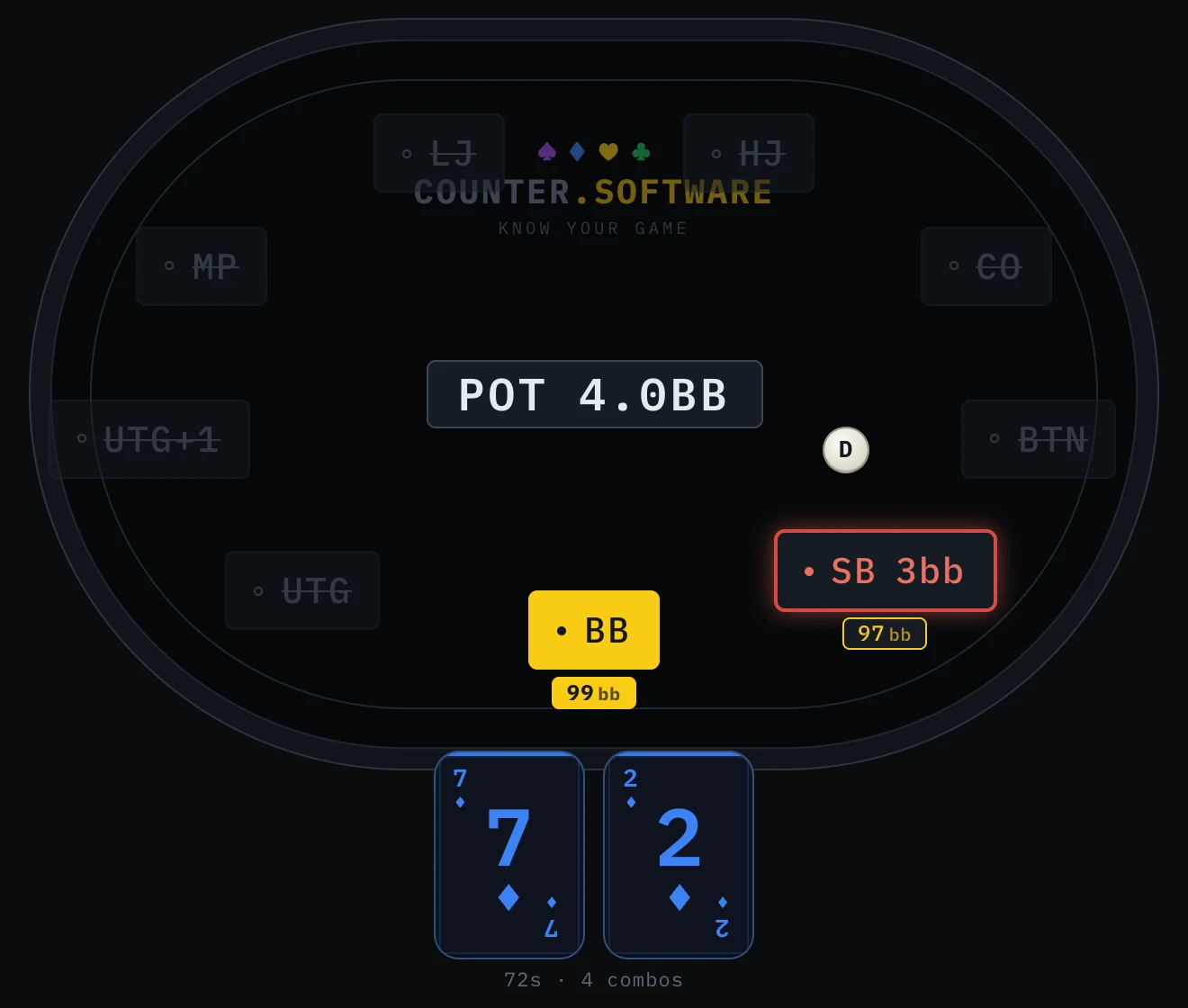
Get dealt a real spot
A hand, a position, a board, weighted by how often it actually reaches you. Or drill one spot until it is automatic.
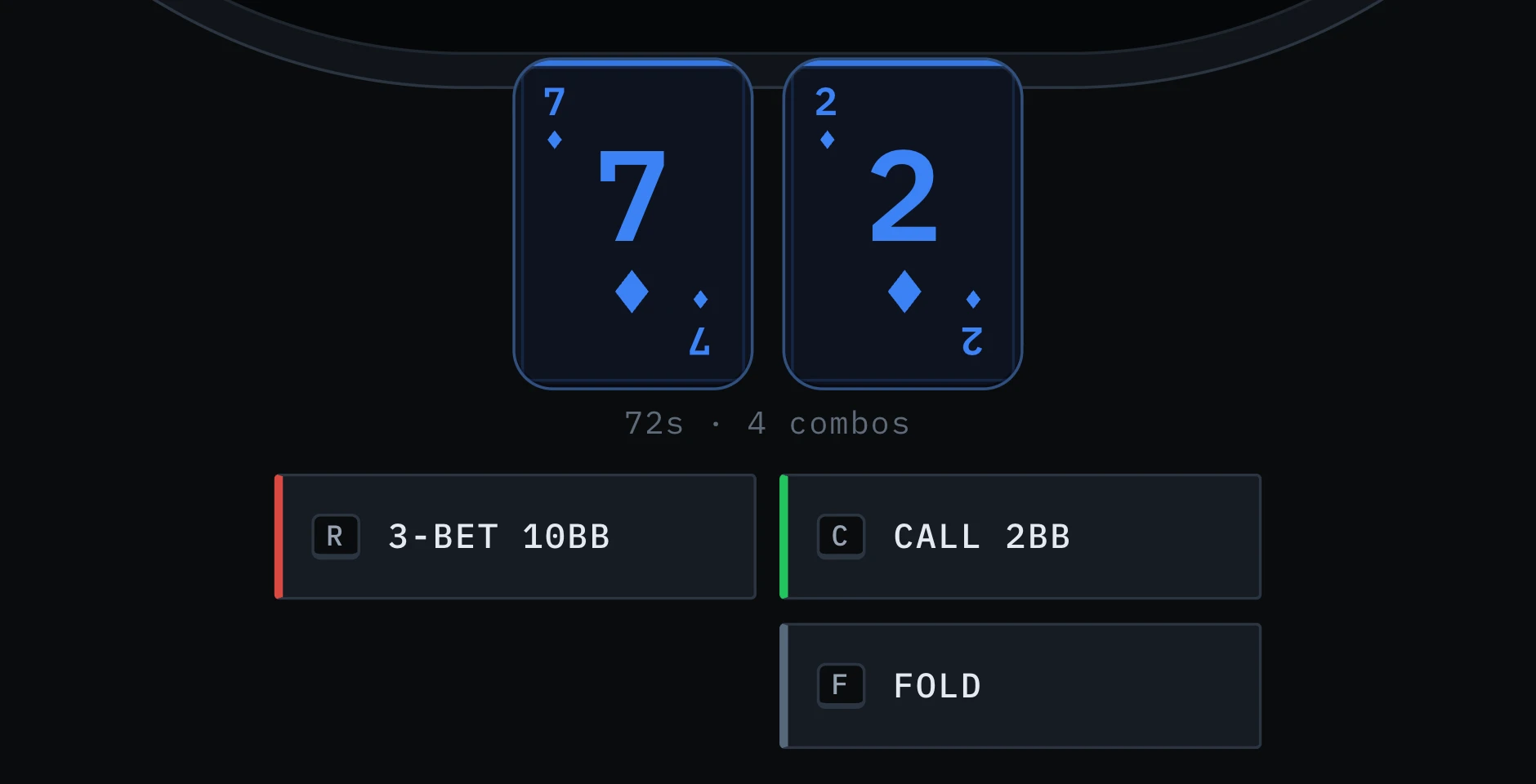
Make the call
Fold, call, raise or pick a sizing, by key or tap. The engine already knows what the solver does with your exact two cards.
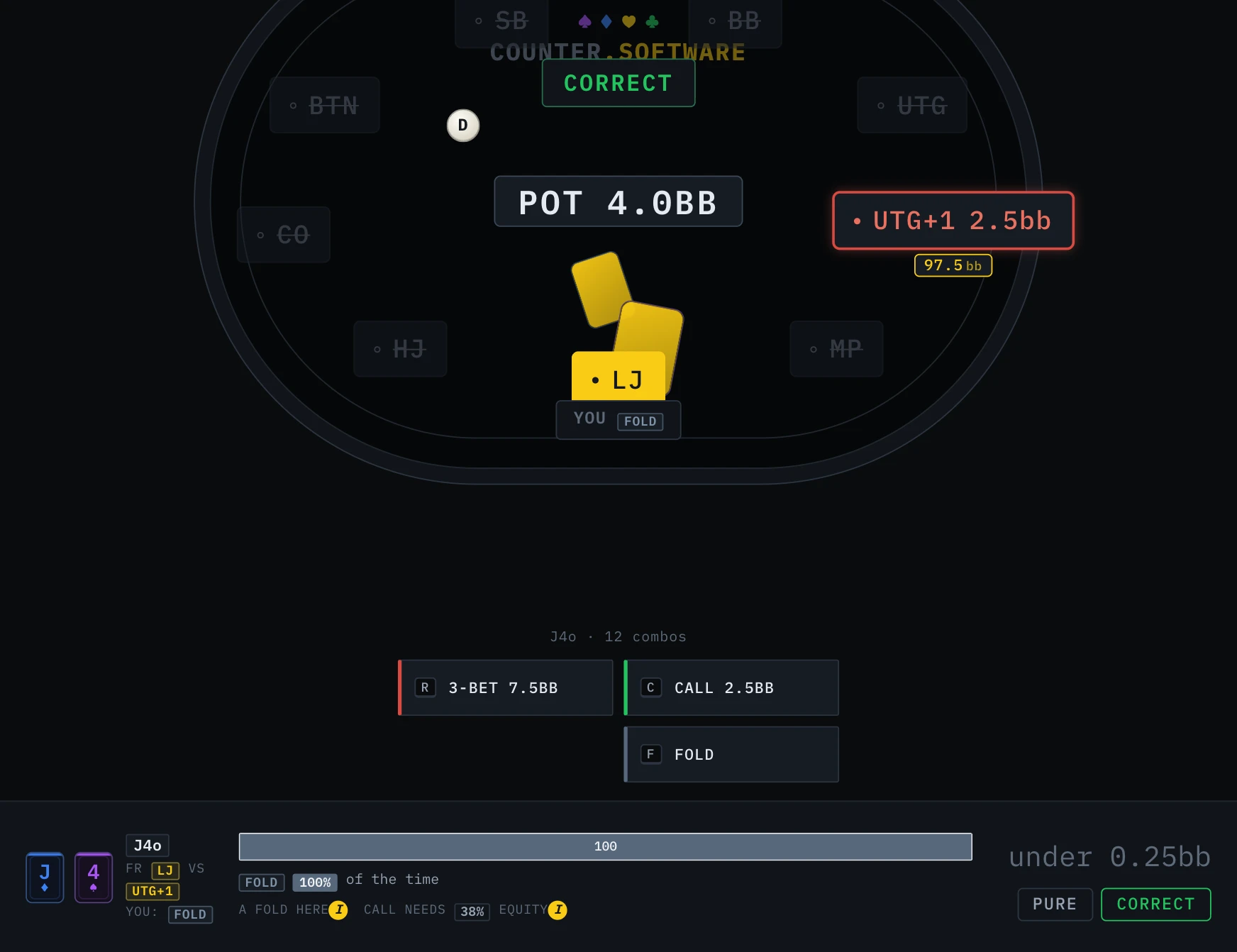
See it priced
Instant verdict with the full mix, the reasoning, and what your choice cost in big blinds. Then the next hand, immediately.
Where the numbers come from
Two kinds of number, never mixed up.
A trainer that grades you to the hundredth of a big blind is making a precision claim, so it owes you the receipt. Not every spot here is a solve, and the app says so on the spot itself.
Solved nodes are real solver output for that exact node, imported with the input file, the exploitability the solve stopped at, and the worst indifference gap left in the reconstruction. Every one is keyed by your exact two cards.
Approximated nodes, all 165 preflop spots, are good enough to drill shape and discipline against, and they are not a solve. The trainer stamps them APPROXIMATED in the spot header. Replacing them with derived solves is the work in progress.
The ranges
See the whole range, not just your hand.
Every spot opens into a 13×13 grid: the solver’s mix, the EV of the best line, and a heat map of your own play against it. This is a real one: the button’s c-bet on K♠7♦2♣, straight out of the trainer.
86o · 8♥6♦ · your exact combo
0.00bbEV lost on this decision
The solver checks this 73% of the time and bets it 27%. Worth +1.37bb against folding — you picked a line it genuinely plays.
↑ The drill screen. Every number in it is read out of the shipped strategy table — the mix, the price, the combo. Open the real thing